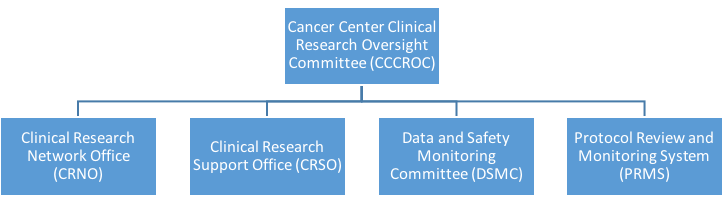
The Clinical Research Support Office (CRSO) is one of the units in the Investigational Trials Resource (ITR); it is divided into 4 units:
The CRSO provides the Helen Diller Family Comprehensive Cancer Center (HDFCCC) with a central core of personnel with expertise in all types of clinical trials management, including protocol project managers (PPMs), protocol development and trial design, clinical regulatory affairs, UCSF compliance and financial management. The CRSO supports investigators in the conduct of cancer-related therapeutic or nontherapeutic clinical trials, with an emphasis on institutional (investigator-initiated) studies.
The objectives of the CRSO:
Forms related to study conduct are located on the CRSO Forms page. Policies & Procedures are located on the ITR Policies page.
For more information about the CRSO, you may contact the Director of Operations, Nicole Lama.
The Early Phase Clinical Trial Program is designed to offer novel therapies to Stage IV cancer patients who otherwise have few treatment options or have tumors that might be best treated with targeted therapies. Solid tumor oncologists, hematologists, neuro-oncologists, pathologists as well as nurse practitioners, study coordinators and a project manager are all part of the Early Phase Program team. This team works with pharmaceutical companies and other researchers, facilitating drug development by applying laboratory results to human clinical trials. The goal is to develop new, effective drug therapies for the treatment of solid tumor and heme malignancies.
The Early Phase physicians have access to generalized and specialized imaging services either within walking distance of the building where the clinical trials are conducted and/or across the multiple UCSF campuses.
The Early Phase Program utilizes space in the Mt. Zion and Parnassus Clinical Translational Science Institute (CTSI) where study visits are conducted and treatment is administered. At each CTSI location there are research trained nurses who administer the study treatments, laboratory technicians and a sample processing lab with freezer storage capability.
The Early Phase Clinic, based at the Mount Zion campus, is the gateway for a patient to receive information about the Early Phase clinical trials appropriate for their particular cancer type. Patients can be referred to the Early Phase Clinic by outside physicians, by UCSF oncologists, or self- referral.
A consultation appointment with an Early Phase physician can be made by calling 415-885-7796. The practice manager will instruct the patient about what medical records should be available to the Early Phase physician at this consultation appointment. A complete physical exam will be performed as well as a thorough review of the patient medical records. If appropriate, the patient will be offered a clinical trial and a sample consent form will be given to the patient to take home to review and discuss with family members and other medical providers, as the patient desires. Once a patient decides that he or she wants to be considered for participation, a screening appointment will be arranged to determine if the patient meets the protocol eligibility requirements.
More information can be obtained by calling the Early Phase Protocol Project Manager at 415-885-7605.
The Research Personnel Unit provides:
Research Personnel management meets regularly with the Lead CRCs to discuss performance issues, provide training in HR procedures and coaching for success, and to disseminate CTMS entry requirements, SAE reporting, and other reporting procedures. Under the direction of the Research Personnel Unit, the Lead CRCs form a working group charged with updating standardized procedures to maintain best practice for GCPs and keep program procedures consistent across the HDFCCC. This Lead CRC working group has developed a Training Resource Portal, modified the current GCP training program to include “Managing Multi-center Trials” and “Train the Trainer” sessions, and addressed training or operational issues that arise from monitoring reports or audits.
The Research Personnel Unit leadership participates in:
Policies & Procedures developed by the Research Personnel Unit are located on the ITR Policies page. Forms related to study conduct are located on the CRSO Forms page.
The Finance Unit is responsible for managing the entire pre-award process for investigator-initiated and industry sponsored clinical trials.
The Finance Unit provides the following services:
The Finance Unit utilizes prioritization data determined by the different Program/Disease Site Committees to establish the priority order for processing MCA, budgets, and contracts.
For more information about the Finance Unit and its services, contact Jubi Nair.
The Protocol Development and Regulatory Unit is divided into three divisions:
The Protocol Development and Regulatory Unit provides comprehensive regulatory support to ensure compliance with the UCSF Committee on Human Research (CHR), HDFCCC Protocol Review Committee (PRC), the NCI, FDA, DOD, and peer reviewed sponsors or foundations.
For investigators who plan to initiate an institutional investigator-initiated clinical trial (non-therapeutic or therapeutic) with the CRSO, they need to work with the appropriate program’s Protocol Project Manager to begin the process. More information and instructions on the process are described below.
For more information about the Protocol Development and Regulatory Unit and its services, contact the Regulatory Affairs Unit Manager Jennifer Ayran.
The role of the Institutional Trials Unit is to ensure regulatory compliance with federal agencies, all components of the internal UCSF review process (PRC, CHR, and other UCSF Committees), and other collaborating sponsors or foundations.
The Institutional Trials Unit is responsible for all protocol and regulatory support required for activation and maintenance of investigator-initiated trials conducted at the HDFCCC, including:
The Institutional Trials Unit also maintains ITR Protocol Templates for Phase I and Phase II investigator-initiated studies.
Below is a timeline for the investigator-initiated protocol development process. The Protocol Project Manager (PPM) begins the process by submitting concepts and protocols to the applicable Program/Disease Site Committee, then submitting the Program/Disease Site Committee-approved protocols to the PRC, and interacting with the CRSO staff to ensure timely completion of study start-up procedures.

The Institutional Trials Unit utilizes prioritization data determined by the different Program/Disease Site Committees to establish the priority order for intiating new investigator-initiated studies. For renewals and modifications of existing investigator-initiated studies, the Institutional Trials Unit determines priority based on the renewal expiration date, patient safety information and study enrollment status.
For more information about the Institutional Trials Unit, contact the Protocol Editors Sandra Tanamugsukbuvon or Jayne Schablaske.
Sponsored Trials Unit
The role of the Sponsored Trials Unit role is to ensure regulatory compliance with federal agencies, all components of the internal UCSF review process, and applicable sponsors.
The Sponsored Trials Unit is responsible for all regulatory support required for activation and maintenance of industry-sponsored trials conducted at the HDFCCC, including:
The Sponsored Trials Unit utilizes prioritization data determined by the different Program/Disease Site Committees to establish the priority order for intiating new industry-sponsored studies. For renewals and modifications, the Sponsored Trials Unit determines priority based on the renewal expiration date, patient safety information and study enrollment status.
Cooperative Groups Trials Unit
The role of the Cooperative Groups Trials Unit is to ensure regulatory compliance with federal agencies, applicable national Cooperative Groups (Children’s Oncology Group [COG], Gynecologic Oncology Group [GOG], ALLIANCE, etc.), and with all components of the internal UCSF review process for national Cooperative Group protocols.
The Cooperative Groups Trials Unit is responsible for all regulatory support required for activation and maintenance of Cooperative Group (National Group) trials conducted at the HDFCCC, including:
The Cooperative Groups Trials Unit utilizes prioritization data determined by the different Program/Disease Site Committees to establish the priority order for initiating new cooperative group studies. For renewals and modifications, the Cooperative Groups Trials Unit determines priority based on the renewal expiration date, patient safety information and study enrollment status.
For more information about the Cooperative Groups Trials Unit, contact Lead Regulatory Affairs Specialist, Helen Chuan.
Acknowledgment
Publications generated from use of this facility should appropriately acknowledge the UCSF Helen Diller Family Comprehensive Cancer Center Clinical Research Support Office.
Additional Resources
A searchable database of core facilities at all UCSF campus locations, provided by the Clinical and Translational Science Institute at UCSF, is available here.