
About UCSF Search UCSF UCSF Medical Center

About Laboratory for Cell Analysis

The Laboratory for Cell Analysis provides cytometric support for the UCSF Helen Diller Family Comprehensive Cancer Center. The LCA was established in 1983 with the following responsibilities:

  • Provide flow and image cytometers and the technical support needed to make use of these instruments.
  • Educate UCSF students, staff, and faculty in cytometry technology and applications.
  • Develop new cytometric methods and new cytometric applications.

The LCA currently occupies four sites within the UCSF community, with cytometers located in the cancer research building on the Mt. Zion campus, Clinical Sciences and Health Science West on the Parnassus campus, Building 1A on the SFGH campus, and Genentech Hall at Mission Bay. The LCA is supporting over 30 instruments representing a long-term capital investment of over $7M.

The LCA was one of the first large cytometry cores in the country and has developed a broad repertoire of instrumentation, technical expertise, and a thoughtful infrastructure to help address a wide variety of experimental demands and novel applications in many model systems. From apoptosis to zymogen assays in organisms from adipocytes to zebrafish, the LCA has accumulated working protocols and a broad theoretical knowledge base to aid Cancer Center investigators.


Services

Contact the Core (415.476.2631 or email) to discuss your research needs and access to LCA services. Core personnel will help you decide which protocols and instrumentation will best suit your needs.

Flow Cytometry, Cell Analysis/Sorting

The LCA provides access and training on one Accuri C6 and four FACS Calibur benchtop cytometers, four LSRII multi-laser digital cytometers, three FACS Aria and one FACS Aria II cell sorters. These systems primarily are for the rapid analysis and sorting of single-cell suspensions. To analyze the light scatter and fluorescence characteristics of a cell population, one of the benchtop machines should be appropriate. For more complex assays requiring more than four differentiating markers, then the high-end multi-laser LSRII systems would work well. To rapidly retrieve or sort a particular sub-group of cells from a mixed sample then a cell sorter would be requested. All LCA flow systems have specialized software for data processing, cell cycle modeling by DNA content, and batch processing of sample data. Listed below are the different LCA cytometers and their properties:

FACS Aria and Aria II are high-speed digital sorters which incorporate a fixed-alignment cuvette flow cell. Fiber optics direct and focus three or four lasers (488nm, 633nm, 561nm, and 407nm or 355nm), depending on which system, onto the alignment prisms, and then focused on the cuvette flow cell. The flow cell allows for improved light excitation and collection optics. The collection optics consist of octagon- and trigon-shaped collection devices, and a total of up to 18 independent signals can be acquired at one time on a single-cell basis, followed by purification of cell subsets by sorting into tubes or multiwell formats.

FACS LSRII from Becton Dickinson is designed for advanced analytical research applications using digital signal processing and flow cell optics, similar to the Aria systems. The LSRIIs are equipped with the latest technical capabilities - high-speed electronics, multiple laser excitations across a wide spectral range (from 405 up to 676nm) and up to eighteen PMT detectors.

FACSCalibur (Mt.Zion, Parnassus, and Mission Bay) is a benchtop flow cytometer designed for applications ranging from routine clinical to basic research. The system analyzes cells as they pass one at a time through two focused laser beams, a 488nm argon-ion laser and a 635nm red-diode laser. The FACSCalibur system is simpler than the LSRII measuring forward light scatter (FCS), side scatter (SSC), and four fluorescence parameters as well as the pulse area and width of any fluorescence parameter and time. The FACSCalibur on Parnassus is equipped with a 40-tube autosampler carousel for walk-away acquisition and analysis. This instrument also has a fluidic sort module for isolating or sorting subpopulations.

Accuri C6 Flow Cytometer is the newest benchtop flow cytometer designed for applications similar to the FACSCablibur but packaged in an all digital electronic instrument. The all digital format means there is no more complex setting of PMT voltages or dealing with logarithmic analog amplifiers. In addition, the C6 includes volumetric sampling so the system can count cells per ml or measure precise volumes (e.g., stop acquisition at 100ul).

Microscopy

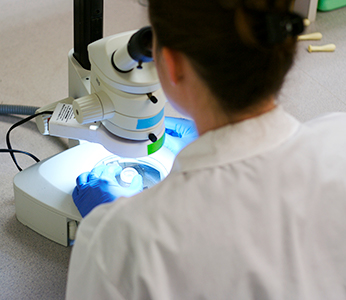
The LCA has several digital microscopes available to users, including new state-of-the-art laser-scanning confocal microscopes from Zeiss located at Mt.Zion (cancer research building), Parnassus (HSW), and Mission Bay (Genentech Hall).

Zeiss Confocal Laser-scanning Microscope LSM 510 NLO and LSM510 META. These microscopes come with four confocal channels for reflected light, plus one for transmitted light. Each channel has individual 12-bit analog-to digital converters to ensure optimum data acquisition. The LSM 510 uses Digital Signal Processor to control data acquisition, scanner operation, and the acousto-optical tunable filters (AOTFs), and it has the capability to change the settings for lasers and detectors very quickly. AOTF is used for tuning the power of each laser line and image acquisition, which means multiple regions of any shape can be selected, scanned with specified laser power, and detected with optimized settings. Another unique feature is the META spectral detection system, which gives the emission spectra at each pixel. This spectral signature facilitates the deconvolution of overlapping dyes and probes. Specialized software for 3D image processing is available for image analysis, including automated measuring functions for the quantitative analysis of 3D and 4D (i.e., time) data sets.

Leica Laser Micro Dissection Microscope. The Leica LMD microscope combines an automated upright microscope, a three-dimensional optical control of the dissection laser beam, and non-contact sample collection by gravity. This is a tool for isolation of single cells or cell groups in preparation for PCA, RT-PCT, and proteomics.

Zeiss Axioplan with Axiocam and Axiovision Software and Leica microscope with openlab. These are general-use, universal microscopes, for use in all areas of light microscopy, including transmitted and incident light microscopy, fluorescent microscopy, darkfield, phase, and polarization contrast.