

Colorectal cancer is rising in adults under 50, and the trend is reshaping how we think about screening, stigma, and care. At UCSF, Drs. Chloe Atreya and Katherine Van Loon, both GI oncologists, are launching a new Young-Onset Colorectal Cancer Program designed to meet the distinct medical and life-stage needs of younger patients.
Below, Dr. Atreya shares why the moment feels urgent—and how a powerful new documentary, André Is an Idiot, featuring a former patient is helping spark awareness, research, and change.
Q. What prompted the creation of a dedicated program for young-onset colorectal cancer at our institution?
It’s been such a long time coming. Patients have been getting noticeably younger over the course of our careers. We’ve been talking about creating a dedicated program since at least 2020, when Black Panther star Chadwick Boseman died of colon cancer at age 43, sending the message that even superheroes can develop colorectal cancer, and sadly also highlighting the stigma and disparities associated with this disease. Then, in 2021, the screening age for colorectal cancer was lowered to 45. Many other comprehensive cancer centers have dedicated programs, exemplified by the one that Dr. Kimmie Ng created at Dana-Farber Cancer Institute—Dr. Ng trained at UCSF and was mentored by Dr. Alan Venook, who heads our gastrointestinal oncology group.
A tipping point for us, though, was the success of André Is an Idiot, a documentary by and about one of my patients who received all his care at UCSF. André Is an Idiot will be released in theaters in March, which is Colorectal Cancer Awareness Month, and we are building momentum together.
Q. How do the needs of younger colorectal cancer patients differ from those of older patients, both clinically and in terms of supportive care?
Younger patients with colorectal cancer tend to be highly motivated to have the best possible chance of survival, and they are usually otherwise healthy, so they are fit to receive aggressive and experimental therapies. They are often willing to travel great distances to receive specialized care at an NCI Comprehensive Cancer Center. Unfortunately, they may also be diagnosed late, with more advanced disease. They don’t necessarily do better than older patients despite intensive treatments and strong immune systems, suggesting biological differences, which may relate to the tumor microenvironment.
In terms of supportive care, there are impacts on fertility and sexual health, financial repercussions that differ from someone at retirement age, and strain on families—including stress experienced by young children, as well as partners and parents. Stress circulates. Additionally, although the incidence of young-onset colorectal cancer is rising, it can be an isolating experience for an individual—usually no one in their friend group has cancer, and cancer treatment can profoundly impact one’s social life and outlook.
"By combining initiatives like this new Young Onset Colorectal Cancer program with projects such as the documentary, we raise awareness, inspire research, and foster truly patient-centered care."
Q. What are the core elements of this new program, and how do they work together to improve the patient experience and outcomes?
One core element is coordinated care. The Cancer Center had many of the ingredients for a dedicated program already, including multidisciplinary expertise and advanced procedural options; what the program will add is navigation—helping patients access these options more easily, consistently, and efficiently. Second, we are adding supportive care options specific to patients with young-onset colorectal cancer, including peer support groups for both patients and caregivers, and I will offer integrative oncology group medical visits. These new options, along with events to bring patients together, will build community, which is associated with both improved experience and outcomes. Third, we are fundraising to support colorectal cancer research at a time when grant funding has undergone substantial cuts. Research funding will enable us to investigate causes of the rising incidence of young-onset colorectal cancer, how to reverse this trend, novel treatment strategies, and how to increase access to complementary modalities like structured exercise coaching, associated with better survival.
Contributions of any amount are meaningful and will directly support program development and early research efforts. Gifts can be made at: https://giving.ucsf.edu/fund/young-onset-colorectal-cancer-program
If you would like to receive updates, invitations to future events, or learn about opportunities to engage, please email us at: [email protected].
Q. Delayed diagnosis remains a major issue in young-onset colorectal cancer. How does the program address awareness, early recognition, and timely care?
A young-onset colorectal cancer program raises awareness—sending a message to the community, primary care providers, and policymakers that this diagnosis is common enough to warrant a dedicated program. It signals to patients that we care deeply about them. We will continue partnering with advocacy organizations like the Colorectal Cancer Alliance and the André Is an Idiot creative team to reduce stigma around colonoscopies and “butt cancer.” Screening colonoscopies aim to remove polyps before they become cancer. While a colonoscopy can be inconvenient, treatment for colorectal cancer at any stage is far more disruptive. Although age 45 is the recommended starting point for routine screening in asymptomatic individuals, diagnostic colonoscopies should occur earlier if symptoms like blood in the stool appear—early detection increases the likelihood of cure. Colorectal cancer can affect anyone. Lifestyle factors such as diet, obesity, lack of exercise, tobacco, and alcohol use influence risk, but people without risk factors can also develop it. We aim to eliminate the shame and self-blame that often accompany this already difficult diagnosis.
Related Events
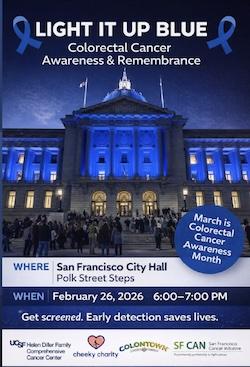
Light It Up Blue!
March is Colorectal Cancer Awareness Month! Please join us for an awareness and remembrance gathering as we light up San Francisco City Hall
Thursday, February 26 | 6 to 7pm
San Francisco City Hall, Polk Street Steps

"André Is an Idiot"
Documentary Film Screenings with Live Q&A
At the Roxie in San Francisco: Wednesday, March 11, 2026
Friday, March 13, 2026
At the San Rafael Film Center in Marin:
Thursday, March 12, 2026
Q. Do genetics and family history play a larger role in colon cancer for younger patients? How is genetic risk assessment integrated into this program?
Approximately 15–30% of patients with young-onset colorectal cancer have a risk factor they were born with. The most common inherited risk factor is Lynch syndrome, although there are many different genetic alterations associated with increased colorectal cancer risk. The current recommendation is to offer a genetic risk assessment, called germline testing, to anyone with a new colon or rectal cancer diagnosis, regardless of age or family history. UCSF has a Hereditary Cancer Clinic to which patients are referred. Identification of a genetic risk factor is important because it can lead to personalized screening recommendations, as well as preventative testing for relatives; however, inherited risk factors are not causing the increase in young-onset colorectal cancer cases.
Q. Please talk more about the increase in young-onset colorectal cancer cases and what might be causing this.
As of January 2026, colorectal cancer is officially the leading cause of cancer death among people in the U.S. under age 50. Cases have been increasing by 1–2% per year for roughly 30 years, with the sharpest increase being in people under age 40. Latino, Black, and Native Americans are disproportionately affected. Rates of other young-onset gastrointestinal malignancies, like appendix, biliary, and pancreas cancer, have been rising as well.
We don’t fully understand the causes of the increase, although diet and physical activity are known factors. Food quality is changing—ultra processed foods have been associated with risk of young-onset colorectal cancer. Paralleling litigation against the tobacco industry in the 1990s, in late 2025, San Francisco City Attorney David Chiu announced a first-of-its-kind lawsuit against 11 of the country’s largest manufacturers of ultra processed foods. Other factors likely include exposure to environmental toxins, such as ingestion of microplastics: we are investigating the gut microbiome for clues.
Q. One of your former patients, André Ricciardi, is featured in a documentary titled André Is an Idiot about living with colorectal cancer. What drew you to participate in that project?
André was a special human, sent to me by the dean of my medical school—who, interestingly, was also a former FDA commissioner known for regulating tobacco and standardizing nutrition labels. André was brilliant and funny, yet “an idiot” because he delayed getting a colonoscopy. What drew me to the project? André, of course. I’ve long been fascinated by how humans create meaning that outlives them. Yet it’s rare for someone to turn a cancer diagnosis into a legacy art project. I had received a commission to co-create art with another patient, but it didn’t come together—so I was an especially enthusiastic champion of André’s work, and hopefully that made a difference. André Is an Idiot, a film following André living with metastatic rectal cancer, completed posthumously, won the Audience Choice Award at Sundance in 2025. How did he pull it off? André sometimes lamented his career in advertising, but he knew skilled, creative people, how to fund a full-length documentary, and how to tell a compelling story. He was charismatic and real, so people believed in his vision.
The film is intimate yet expansive. André’s best friend, Lee; wife, Janice; and their two daughters all participated, which is powerful to witness. Curious about the human experience, André approached even outlandish claims—like head transplants in Italy—with honesty and humor. Clinic visits with him were unique. Finally, his influence is positive: by speaking openly about cancer, colons, and dying, André helped save lives.
Q. Please share anything you’d like about André.
André participated in our very first series of Mindfulness Practices to Promote Health During Cancer Treatment group medical visits. We are now in series 40. He provided helpful feedback, including that we could benefit from a catchier title, which is true, although we have yet to come up with one. He signed consent for me to share anything he said, so he is quoted in our paper. He is also featured in my UCSF Our Calling video, because I told the producers that I had one patient who I knew was comfortable being on camera. Everyone loved André. One touching moment was his very last visit to the UCSF infusion center at Mission Bay. The nurse practitioner I work with, Megan Kennedy, and I went to see him. As he left to go home, all the nursing staff lined up, forming a receiving line like at a wedding, to pay their respects. I’ve never experienced anything like that. Later, I heard from Janice that André was personally insistent on including the “very special thanks” to UCSF in the film credits, where he acknowledges “all the magical chemo nurses.”
Q. Although André was older when he was diagnosed, how do you think his story helps audiences better understand colorectal cancer and the importance of comprehensive care?
I want to clarify that André had recently turned 52 when he was diagnosed with very advanced rectal cancer. After he passed, one of the film producers contacted me to fact-check—André said that his CEA tumor marker was over 30,000 at diagnosis, which didn’t seem humanly possible (normal is <5 micrograms/L). However, like many of the things that André said which sounded unbelievable, it was true. The sobering reality is that, had André undergone a screening colonoscopy at age 50, as was the recommendation at the time, he likely would still be with us. Had he undergone a diagnostic colonoscopy when he first started noticing blood with bowel movements, he would have been diagnosed with young-onset colorectal cancer and may have been cured. Had he undergone a screening colonoscopy at age 45, the current screening age, he may have had a polyp removed and avoided cancer altogether. After his diagnosis, André’s goal was to harness his talents and connections as an advertising executive to create an effective public service announcement which will spur others to avoid repeating his misfortune. Already, I’ve heard about friends, and friends of friends, who were inspired by André’s story to schedule a potentially lifesaving colonoscopy.
Regarding the importance of comprehensive cancer care, what struck my mentor, Dr. Alan Venook, when he saw the film was the underlying trust. The film distribution team refers to UCSF as a character in the movie. Rather than being a focus (and source of angst), we play an unobtrusive supporting role. We provided the solid backdrop against which André got to use his energy to live life and make art. Comprehensive cancer care, at its best, should be wraparound and seamless.
By combining initiatives like this new Young Onset Colorectal Cancer program with projects such as the documentary, we raise awareness, inspire research, and foster truly patient-centered care.