
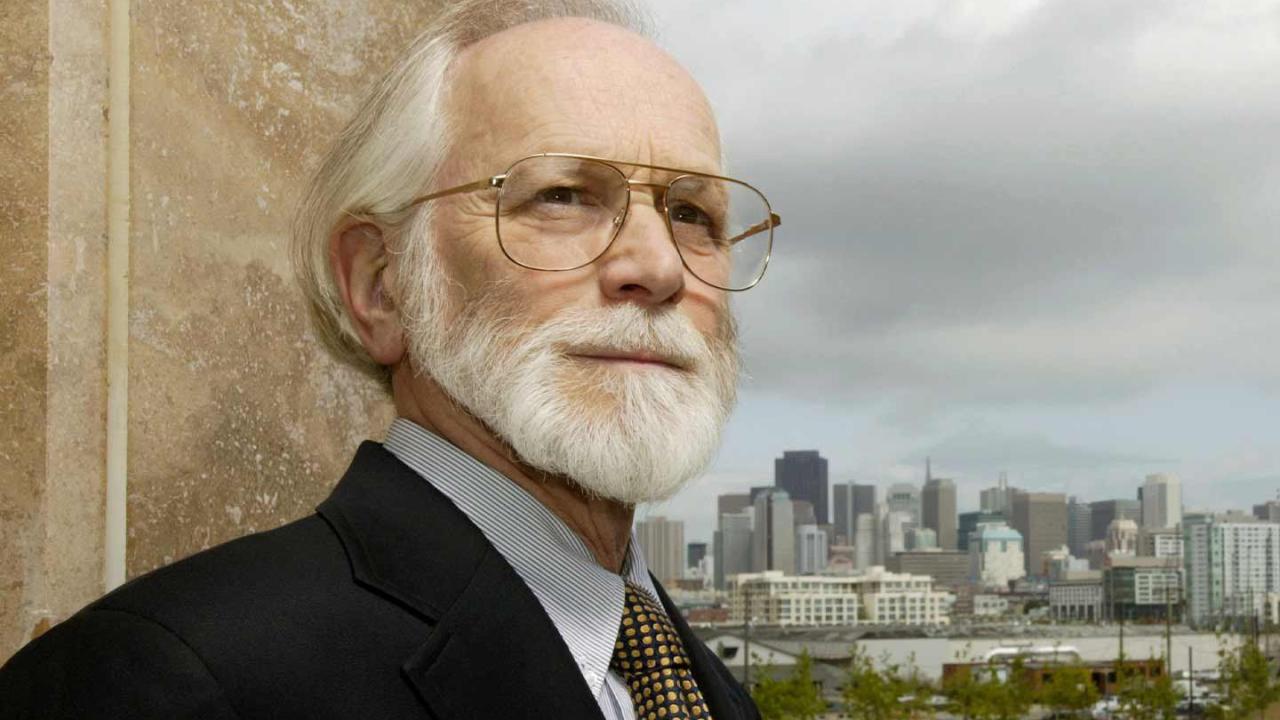
UC San Francisco Chancellor emeritus J. Michael Bishop, MD, a pioneering microbiologist who shared the 1989 Nobel Prize in Physiology or Medicine for discovering that every cell in the body harbors genes that can cause cancer, has died at the age of 90.
“Mike Bishop was a titan of science and a pillar of the UCSF community,” said UCSF Chancellor Sam Hawgood, MBBS. “His research forever changed our understanding of cancer and its underlying causes.
“As chancellor, he oversaw the development of UCSF’s Mission Bay campus, reshaping the university to meet the challenges of 21st century science and medicine,” Hawgood continued “He was a transformative figure, and his passing represents a tremendous loss for UCSF and the wider scientific community.”
Reshaping the way scientists think about cancer
Bishop joined the UCSF faculty in 1968, an era when cancer biology was in its infancy. At the time, several seemingly incongruous ideas attempted to account for the biological origins of cancer. Some argued that the disease resulted from exposure to harmful environmental agents such as chemicals and viruses, which were, even at the time, known to cause cancer. But this view didn’t square with the observation that cancer runs in families. That suggested a genetic component was also at work.
Soon after arriving at UCSF, Bishop began work on Rous sarcoma virus (RSV), a virus known to cause cancer in chickens, in research that would unexpectedly lay the groundwork for his Nobel Prize–winning discoveries.