
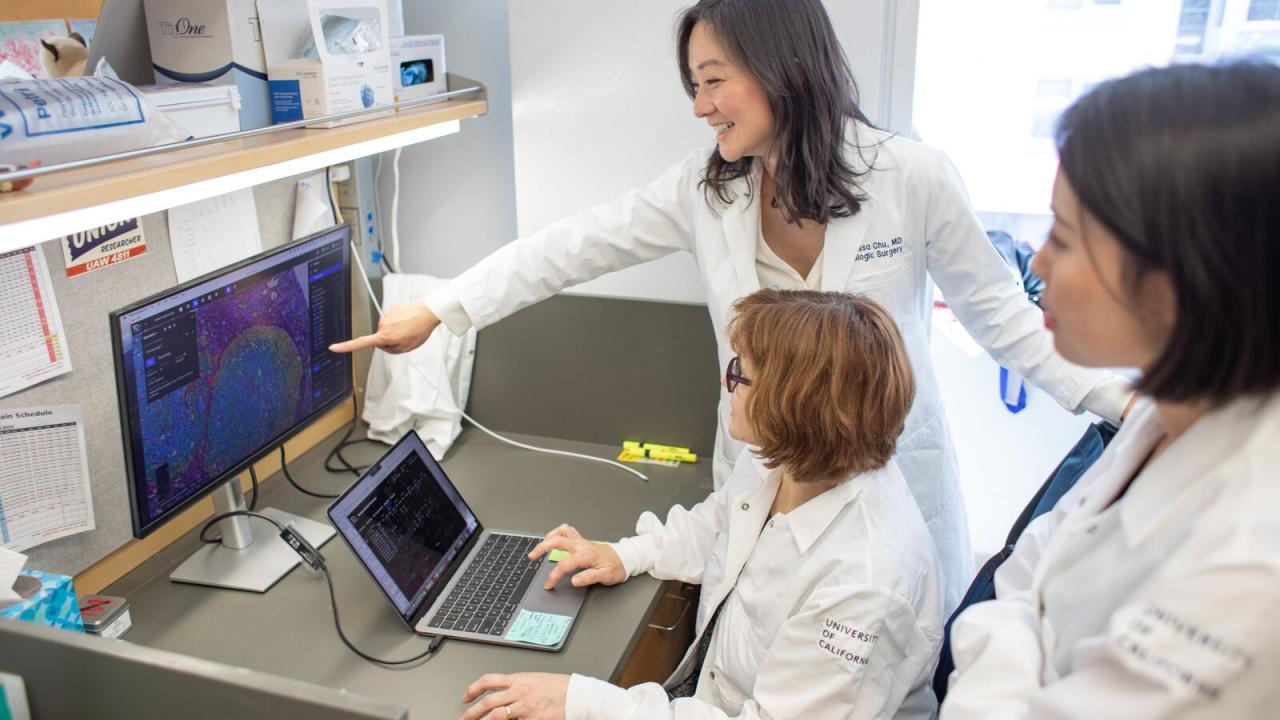
Researchers work in the Dr. Carissa Chu urological cancer lab at the UCSF Helen Diller Family Comprehensive Cancer Center.
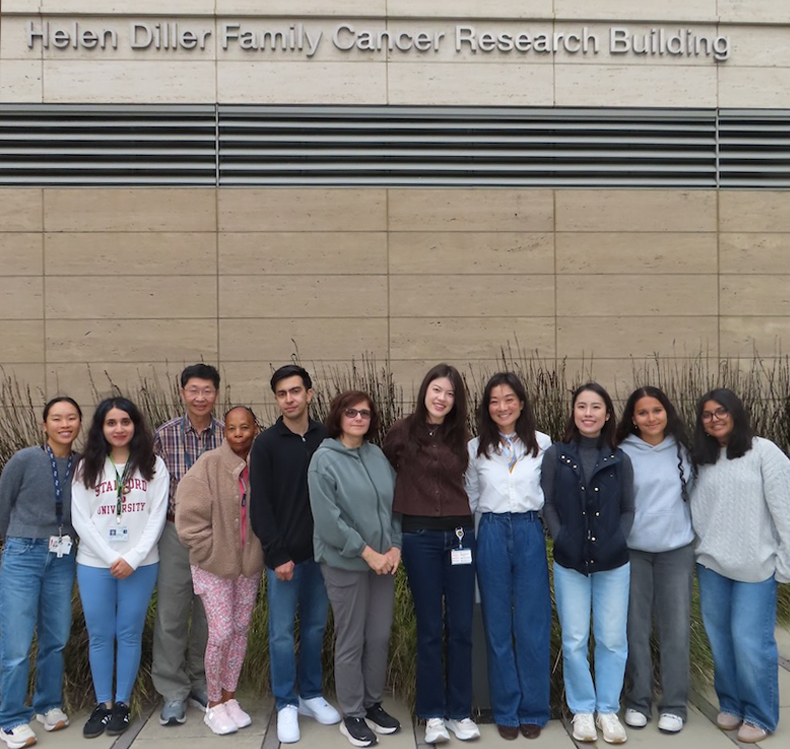
Just three years after launching her laboratory at UCSF, urologic oncologist Carissa Chu, MD, is entering a new phase of growth. This summer, her lab will expand to eleven members, nine of whom are women, marking a milestone as she pursues more personalized treatments for prostate and bladder cancer.
An assistant professor in the UCSF Department of Urology and the Stephen and Faith Brown Endowed Professor in Urology, Dr. Chu treats patients with urologic cancers while leading a translational research program focused on improving outcomes and cure rates for lethal disease.
By studying tumors surgically collected from patients and recreating key aspects of those cancers in the laboratory, Dr. Chu and her team are identifying biomarkers that predict treatment response and developing strategies to make therapies more effective.
"We learn things directly from patients' tumors by characterizing them in detail," Dr. Chu said. "Then we try to model those observations in the lab and understand how we can improve treatment response."
Building on a Transformative Therapy
A major focus of the lab is enfortumab vedotin (EV), a targeted therapy that has transformed treatment for advanced bladder cancer by delivering its cancer-killing payload directly to tumor cells that express the surface protein NECTIN4. While EV has improved survival for many patients, not everyone responds equally.
"Our research has focused on defining who benefits most from EV and why," Dr. Chu said. "Now we are working on the next big leap, which will be to make it work for more patients, last longer, and with fewer side effects."
Her laboratory has shown that tumors expressing higher levels of NECTIN4 tend to respond better to EV. More recently, the team identified retinoic acid signaling as a key regulator of NECTIN4 expression and treatment sensitivity, suggesting existing vitamin A-related compounds could make tumors more responsive to therapy.
Dr. Chu's team is also investigating how the tumor microenvironment influences treatment. Using spatial transcriptomics, researchers identified a distinct immune-cell neighborhood associated with exceptional responses to EV.
"Not all bladder cancers are the same," Dr. Chu said. "It's actually a mosaic of different types of cells and their individual interactions with each other matter."
Understanding that complexity could help physicians better match patients with therapies while avoiding unnecessary toxicity. Her long-term goal is to develop biomarkers from tumor tissue, blood and urine that can guide treatment decisions and mitigate resistance.
Expanding Precision Medicine to Prostate Cancer
Dr. Chu's lab is also advancing precision approaches for prostate cancer. The team is studying STEAP1, a promising therapeutic target expressed on prostate cancer cells, using whole-genome CRISPR screening and molecular profiling to understand how its expression is regulated and why it varies across patients and stages of disease. Those discoveries could help identify patients most likely to benefit from emerging targeted therapies and inform the development of new treatment combinations.
Bringing Patient Tumors Into the Lab
Another priority is developing patient-derived tumor models. Traditional laboratory systems often fail to capture the complexity of human cancers, so Dr. Chu's team is testing new approaches, including "tumor-on-a-chip" platforms, that better preserve the tumor microenvironment.
"There is a big disconnect between the handful of cell lines that we use and what's actually happening within the patient," Dr. Chu said. "Developing better models is going to be part of the future for us."
A Growing Team, A Shared Mission
Since opening in 2023 with a single employee, Dr. Chu has built a team of postdoctoral scholars, fellows, residents, medical students and undergraduate trainees. Nine of the lab members are women, a dynamic that emerged organically and has given Dr. Chu the opportunity to mentor the next generation of scientists.
"It's very empowering," she said. "These are talented and driven people. I really want to support in their careers and witness their success. When they win that grant or award or deliver an engaging presentation – that's the best feeling. We are working hard to make an impact and push the science."
As her lab enters its next phase, Dr. Chu remains focused on translating laboratory discoveries into better outcomes for patients and moving closer to more precise, personalized treatments for urologic cancers.
Dr. Chu is funded by the NIH National Cancer Institute and UCSF Prostate SPORE, Prostate Cancer Foundation, American Association for Cancer Research, Cancer Research Institute, Benioff Initiative for Prostate Cancer Research, UCSF Department of Urology, and generous patient donors including the Stephen and Faith Brown Endowed Professorship.