
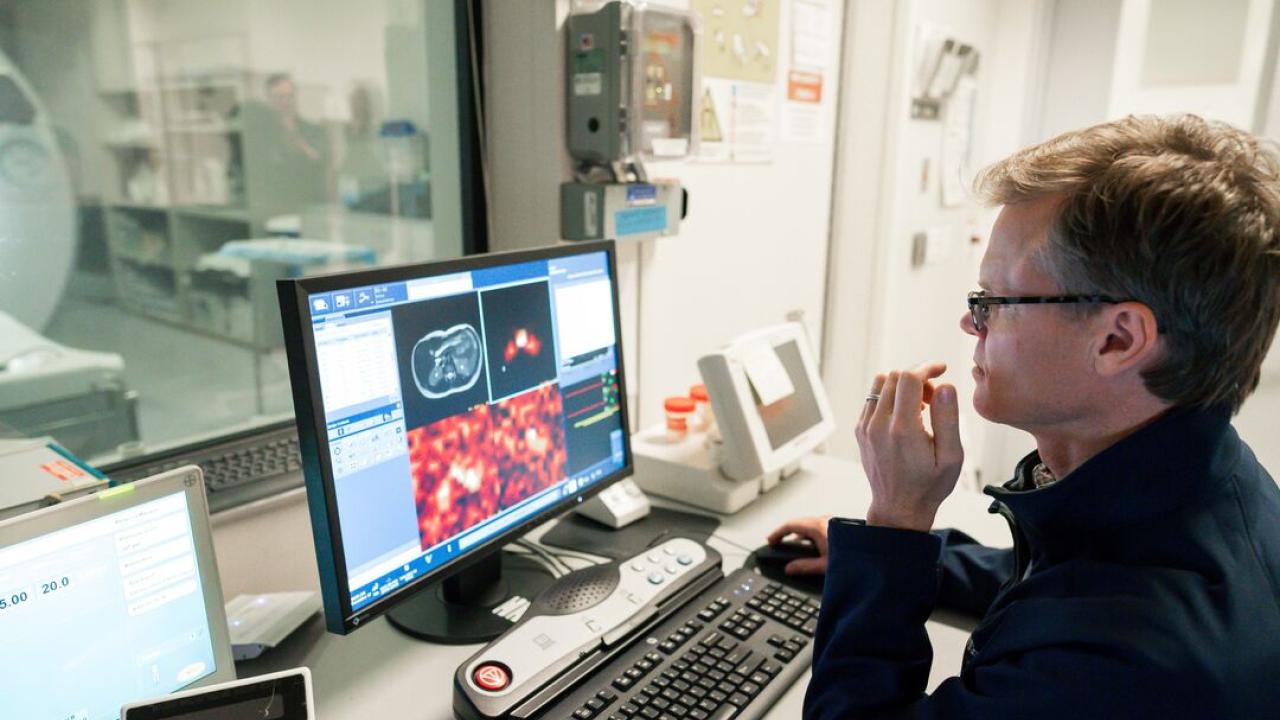
Photo: Peder Larson, PhD, one of the Spring 2026 RAP awardees, works with advanced imaging technology at UCSF.
Nine investigators and teams were awarded grants in support of cancer research projects in the spring 2026 cycle of the UCSF Resource Allocation Program (RAP). Funded by various agencies across UCSF, the awards span a range of topics from digital health and drug discovery to imaging, survivorship, epidemiology, and more.
RAP is a campus-wide program that bi-annually facilitates intramural research funding opportunities and seeds high-quality, high-impact, timely research. The program offers many benefits for investigators and campus agencies, including a single application, a streamlined review process, and access to funding that has a typical funding rate of 30 percent.
Read more about the recent awardees and their cancer research projects below.

Serine Avagyan, MD, PhD
Assistant Professor of Pediatrics, UCSF
Project: Perinatal inflammation as a risk factor for neonatal pre-leukemic clonal hematopoiesis
Award Mechanism: Pilot for Early Career Investigators
Can you describe the focus of your project in a few sentences?
The origins of childhood B-cell acute lymphoblastic leukemia can be traced to before birth, when developing blood cells acquire leukemia-associated genetic changes that create pre-leukemic clones. Most of these clones never progress to leukemia. Much research has focused on factors that promote leukemia development after birth. Our project focuses on the developmental origins of the pre-leukemia and factors that may promote their selective growth advantage. We will investigate whether perinatal inflammation found in neonatal blood creates an environment that allows these clones to persist or expand. Using healthy newborn cord blood, we will screen for pre-leukemic clones positive for the most common B-ALL oncofusion called ETV6::RUNX1, and profile gene-expression patterns, particularly inflammatory signatures, associated with their presence.
What motivated you to pursue this particular research?
As clinicians who care for children through years of intensive chemotherapy and its lasting effects, we are drawn to understanding and finding ways to intervene at the earliest stages of disease rather than only treating it once it emerges. Evidence that inflammatory signaling promotes survival of preleukemic clones suggested a concrete, testable link between perinatal biology and leukemia risk in B-ALL oncofusion-positive clones. If we can establish that prenatal inflammation is associated with fusion positivity, it would open the door to identifying inflammatory signatures that flag high-risk pregnancies or infants for closer monitoring, earlier diagnosis, or eventual prevention.
This project was funded by the Research Evaluation & Allocation Committee (REAC), UCSF School of Medicine.

Mark Zhao, MD
Assistant Professor of Clinical Surgery, UCSF
Project: Leveraging Digital Health Solutions to Collect Patient-Reported Outcomes in Rectal Cancer
Award Mechanism: Pilot for Early Career Investigators
Can you describe the focus of your project in a few sentences?
This project will leverage digital health technology to improve collection of patient-reported outcomes from patients undergoing treatment for rectal cancer. By embedding validated surveys into the MyChart patient portal, the study will evaluate a scalable approach to understanding how treatments affect quality of life and patient decision-making over time. Findings from this work will lay the foundation for future multicenter studies and support more patient-centered approaches to colorectal care.
What motivated you to pursue this particular research?
This project sits at the intersection of both colorectal surgery and clinical informatics. In my discussion with collaborators across the country, it was apparent that there was a dearth of patient-reported outcomes data in patients undergoing treatment for rectal cancer, and one of the reasons was that it is very difficult and resource-intensive to collect this data. Given my background in informatics, I hope to leverage digital health technologies to lower these barriers to data collection and ultimately improve the care we provide to patients undergoing rectal cancer treatments.
This project was funded by the Cancer Center Support Grant (CCSG) of the UCSF Helen Diller Family Comprehensive Cancer Center.

Elena Portacolone, PhD, MBA, MPH
Professor of Sociology, Institute for Health & Aging, UCSF
Project: Bridging research and policy to support older adults living alone with pancreatic cancer
Award Mechanism: Pilot Award for Diseases of the Pancreas
Can you describe the focus of your project in a few sentences?
Our goal is to identify the unique challenges that older adults face in accessing critical services because they live alone while navigating pancreatic cancer. To better understand these challenges, I will conduct interviews with older adults living alone with pancreatic cancer to learn directly from their lived experiences. I will also interview healthcare professionals who care for this population to gain their perspectives on the barriers these patients encounter and to identify opportunities for improving care and support.
What motivated you to pursue this particular research?
My motivation for this work stems from the massive knowledge gaps surrounding the experience of living alone with cancer and my research on living alone in later life.
Only recently has quantitative research begun to reveal the consequences of living alone for older adults with cancer. Studies in the United States have shown that older adults with cancer who live alone have poorer survival than those living with others. Similarly, a recent study from Japan found that some patients with pancreatic cancer who lived alone chose not to pursue treatment, instead allowing the disease to progress untreated. Despite these important findings, we know remarkably little about what it is actually like to live alone with pancreatic cancer—or with other cancers. The lived experiences, challenges, and decision-making processes of these individuals remain largely unexplored, representing a major gap in cancer research.
I am passionate about addressing this gap because, for more than a decade, I have been concerned about the disparities experienced by older adults who live alone. Living alone is not a rare circumstance in later life—it is increasingly the norm. In the United States, more than half of households headed by someone age 75 or older are single-person households. Understanding and addressing the unique needs of this growing population is essential to advancing equitable, patient-centered cancer care.
This project was funded by the UCSF Pancreas Center Program.

Rosemary Akhurst, PhD | Veronica Steri, PhD | Juan Antonio Camara Serrano, PhD, DVM
Team: Preclinical Therapeutics Core, Helen Diller Family Comprehensive Cancer Center
Project: Improving and expanding preclinical ultrasonography service at UCSF
Award Mechanism: Core Award for Research and Development (CARD)
Can you describe the focus of your project in a few sentences?
The RAP Award for “Improving and Expanding Preclinical Ultrasonography Service at UCSF” will support the acquisition of a state-of-the-art ultrasound imaging system dedicated to in vivo preclinical research at the Parnassus campus. This new technology will substantially expand the imaging capabilities available to UCSF investigators and support a broad range of biomedical research applications, including high-resolution anatomical and physiological assessment of soft tissues, real-time functional imaging, and ultrasound-guided procedures and surgeries. By establishing these capabilities at Parnassus, the project will provide researchers with more direct access to advanced, non-invasive imaging technologies and enable new opportunities for preclinical and translational research.
What motivated you to pursue this particular research?
The primary motivation for this project was the need to strengthen in vivo imaging capabilities at the Parnassus campus, where access to advanced preclinical imaging technologies has been limited in recent years. Currently, some studies require laboratory animals to be transported between UCSF campuses to access specialized imaging equipment. Establishing advanced ultrasonography capabilities directly at Parnassus will reduce the need for these transfers, improving both research efficiency and animal welfare by minimizing transportation and associated stress. Importantly, reducing animal movement between campuses will also help mitigate the risk of transferring microorganisms between animal facilities. Overall, this investment will address an important infrastructure need while providing UCSF researchers with safer, more efficient, and more accessible tools for high-quality preclinical research.
This project was funded by the UCSF Research Resource Program.
Jie Liu, PhD, MS
Postdoctoral Scholar, Cellular and Molecular Pharmacology, UCSF
Project: Helicase-enabled covalent RNA inhibitors for pancreatic cancer drug discovery
Award Mechanism: Mentored Scientist Award in Diseases of the Pancreas
Can you describe the focus of your project in a few sentences?
My project focuses on developing covalent RNA inhibitors as a new way to address difficult therapeutic targets in pancreatic cancer. Rather than targeting proteins that are challenging to drug directly, we aim to discover small molecules that bind RNA and modulate protein translation upstream. More broadly, this work explores covalent RNA targeting as a new therapeutic modality that could expand the range of targets accessible to drug discovery.
What motivated you to pursue this particular research?
I was motivated to pursue this research because I was trained as an organic chemist and have been increasingly interested in applying chemistry to major unmet biomedical challenges. Pancreatic cancer is one of the most urgent of those challenges: despite progress in targeting oncogenic KRAS in pancreatic ductal adenocarcinoma, advanced disease remains difficult to treat because of pathway plasticity, co-mutations, and a highly immunosuppressive tumor microenvironment. Most previous efforts have focused on targeting proteins directly or using combination therapies. We believe RNA targeting offers a creative and potentially powerful complementary strategy. If successful, this work could open new therapeutic opportunities not only for pancreatic cancer but also more broadly for diseases driven by targets long considered “undruggable.”
This project was funded by the UCSF Pancreas Center Program.
Carolyn Harris, PhD, RN
Assistant Professor, Physiological Nursing, UCSF
Project: Elucidation of the Molecular Mechanisms of Symptom Burden in Patients with Cancer: A Multi-Staged Data-Integrated Multi-Omics Analysis
Award Mechanism: Pilot for Early Career Investigators
Can you describe the focus of your project in a few sentences?
Despite advances in treatment, a large amount of inter-individual variability occurs in the symptom burden of oncology patients. A higher symptom burden is associated with poorer performance status and lower quality of life, and may lead to dose reductions, delays, and/or cessation of treatments that decrease overall survival. To develop and test interventions to prevent or alleviate patients’ symptom burden, information is needed on the underlying molecular mechanisms that contribute to inter-individual variability in symptom burden profiles. This study builds on our team's recent work that characterized the symptom burden phenotype and identified differentially perturbed immune and inflammatory signaling pathways between patients with Low and High symptom burden. For this project, we will conduct a multi-staged data-integrated multi-omics analysis to determine the relative contribution of inherited genetic variation and gene regulation to these perturbed signaling pathways.
What motivated you to pursue this particular research?
To develop and test mechanistic-based, patient-centered interventions, improved understanding is needed on what drives the inter-individual variability in the patient's symptom experience that we see clinically. This study will shed important light on the molecular mechanisms that contribute to these differences.
This project was funded by the UCSF Clinical and Translational Science Institute (CTSI).

Erin Van Blarigan, ScD
Professor, Depts. of Epidemiology & Biostatistics and Urology, UCSF
Project: Supporting the Optimization of Behavioral Interventions for Cancer Survivors
Can you describe the focus of your project in a few sentences?
The goal of the Tools To Be Fit trial is to optimize a behavioral intervention to help cancer survivors adopt the American Cancer Society (ACS) Nutrition and Physical Activity Guidelines. This RAP award will be used to support additional biomarker assessments and study personnel, allowing us to better understand how changes in nutrition and physical activity behaviors may influence important health outcomes among cancer survivors.
What motivated you to pursue this particular research?
Adherence to the ACS Nutrition and Physical Activity Guidelines is strongly associated with lower risk of cancer recurrence and mortality. Yet national data suggest that only 4% of cancer survivors in the U.S. closely follow these guidelines. This gap represents an important opportunity to improve cancer survivorship. Our research group uses innovative study designs to identify which components of behavioral interventions work best, for whom, and under what circumstances. Our ultimate goal is to develop effective, scalable, and sustainable programs that help cancer survivors make lasting changes to their health behaviors and improve their long-term health outcomes.
Peder Larson, PhD
Professor of Radiology, UCSF
Project: Precision Imaging of Cardiotoxicity: Metabolic MR Biomarkers for Pathophysiology, Early Detection, and Cardio protection effect monitoring
Award Mechanism: Team Science Grant
Can you describe the focus of your project in a few sentences?
Patients undergoing advanced cancer treatments often experience side effects that affect their heart, known as cardiotoxicity. Often, these effects are not detected until there is significant loss of heart function, at which point it may be too late to correct. Our team has been developing advanced MRI methods for non-invasively measuring metabolism in heart disease, which we believe will benefit cancer patients as well. This team science project from UCSF faculty in Radiology and Cardiology will use these tools to better understand cardiotoxicity, provide early detection, and evaluate the effects of treatments.
What motivated you to pursue this particular research?
This work started when a radiologist clinician-scientist from South Korea visiting my lab brought this idea to us. She worked with my team to perform preliminary studies combining the novel MRI methods with a preclinical cardiotoxicity model. We then connected with Dr. Moslehi, an international expert in cardio-oncology, who was very encouraging and supportive of developing this idea further as a collaborative research project.
This project was funded by the Research Evaluation & Allocation Committee (REAC), UCSF School of Medicine.

Karla Kerlikowske, MD
Professor of Medicine, UCSF
Project: San Francisco Mammography Registry; A Research Resource
Dr. Karla Kerlikowske is Professor of Medicine and Epidemiology and Biostatistics at UCSF, Co-Director of the Women’s Clinic and Director of the Women’s Health Fellowship at the San Francisco Veterans Affairs Medical Center. Her clinical research focuses on cancer epidemiology including studies of breast imaging, breast cancer risk assessment, breast density, and epidemiology of invasive breast cancer and DCIS.
Looking Ahead: Fall 2026 Cycle
The next UCSF Resource Allocation Program (RAP) application cycle opens August 27. Explore available funding opportunities and submit your application by September 28, 2026, at 2 pm.