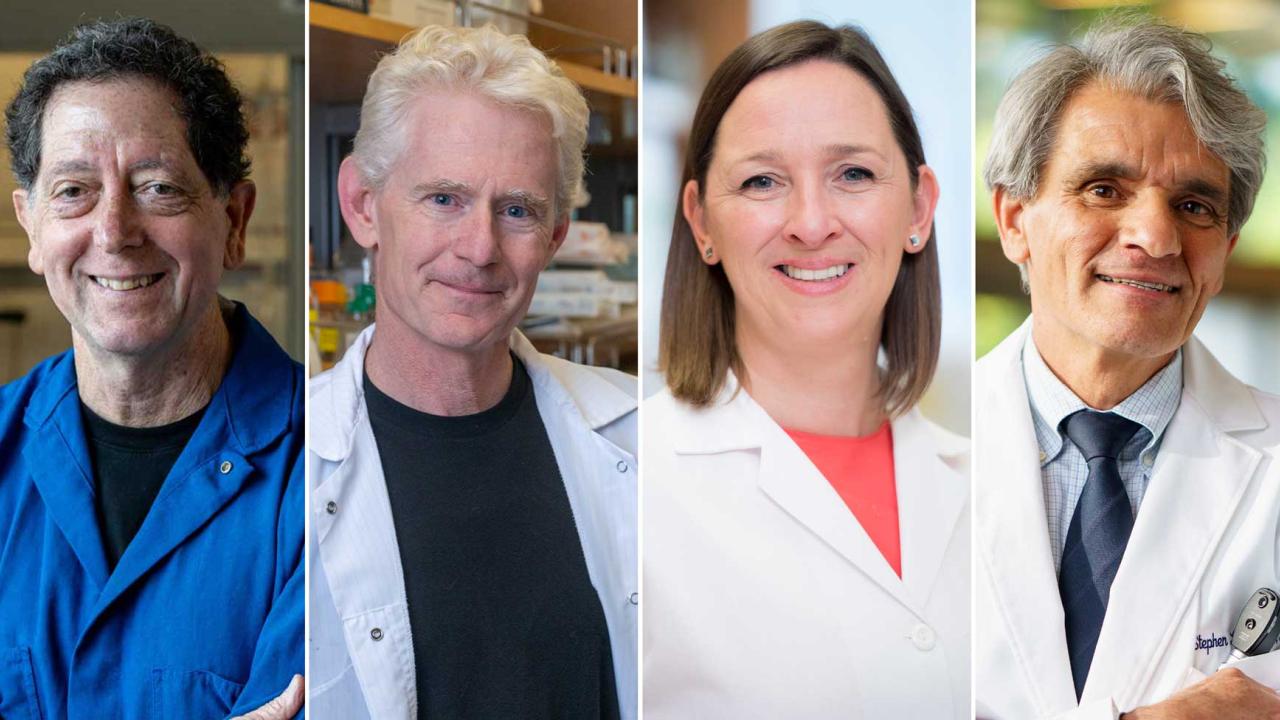
From left toright: Kevan Shokat, PhD, winner of the Gamechanger Award; Joseph DeRisi, PhD, winner of the Best Startup Award; Susan Lynch, PhD, winner of the Disruptive Research Award; and Steven Hauser, MD, winner of the Distinguished Lifetime Achievement Award.
Four UC San Francisco professors received UC Regents Innovation Awards on Sept. 16, celebrating their accomplishments transforming multiple sclerosis care, advancing faster disease diagnostics, pioneering microbiome-based disease prevention, and developing new approaches to precision cancer therapies.
Presented at a dinner at the UCLA Luskin Conference Center, Kevan Shokat, PhD, won the Gamechanger Award; Joseph DeRisi, PhD, won the Best Startup Award; Susan Lynch, PhD, won the Disruptive Research Award; and Steven Hauser, MD, won the Distinguished Lifetime Achievement Award.
This is the inaugural year of the UC Regents Innovation Awards, which honor faculty and researchers who turn groundbreaking research into practical solutions that address pressing challenges and improve people’s lives. Each year, three winners are selected from UC’s 10 campuses and three national laboratories in the categories: Gamechanger Award, Disruptive Research Award, Best Startup Award, Community Changemaker Award, and Distinguished Lifetime Achievement Award.
The winners of the Gamechanger, Disruptive Research, and Best Startup awards each receive a cash prize of at least $10,000.
Stops cancer cells from growing
Kevan M. Shokat, PhD, professor of cellular and molecular pharmacology, received the Gamechanger Award, which recognizes the most impactful product brought to market. Shokat pioneered a new way to target KRAS, a protein produced by a mutated gene that drives roughly 20% to 30% of cancers, including many lung, colorectal, and pancreatic tumors. His achievements are reshaping cancer drug development and creating a new generation of precision cancer treatments.
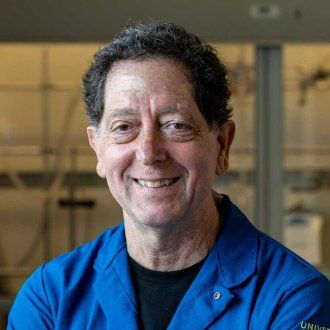
For decades, KRAS was considered “undruggable” because scientists could not find a way for drugs to attach to the protein without also affecting healthy cells. Shokat and his team discovered a previously hidden pocket in a mutated form of KRAS called G12C, creating a way to target cancer cells while largely sparing normal cells.
Their breakthrough enabled the development of drugs that block the mutated KRAS protein and stop cancer cells from growing. One such drug, sotorasib, became the first FDA-approved treatment to target KRAS G12C, giving some patients with advanced lung cancer a new treatment option. Now, more than 50 KRAS-targeting drugs are in clinical development.
Shokat’s work also helped establish a broader principle in drug discovery: proteins once considered impossible to target may have hidden vulnerabilities that can be exploited with precisely designed medicines. His research has earned numerous national and international honors, including the National Academy of Sciences Award for Scientific Discovery and the Sjöberg Prize. He co-founded several biotechnology companies, including Revolution Medicines, Kura Oncology, and Araxes Pharma — all to develop new therapies against KRAS and related cancer targets.