

Latest Cancer Health Outcomes SPORE awardees: William S. Chen, MD, Alice Guan, PhD, MPH, Andrea Gillis , MD, MSPH, Salma Shariff-Marco, PhD, MPH, Harish Vasudevan, MD, PhD, and Ramin Morshed, MD.
Six cancer research investigators are receiving grants this fall through the Cancer Health Outcomes Specialized Program in Research Excellence (CHO SPORE). This grant program, funded by the National Cancer Institute, supports translational research at UC San Francisco studying the biological and external factors influencing health outcomes across different types of cancers.
The SPORE, with strong institutional support, also provides funding for early-career scientists and innovative, high-risk investigations through the Career Enhancement Program (CEP) and the Developmental Research Program (DRP), respectively. These pilot projects help fuel new ideas and collaborations across UCSF and its partner institutions.
“Building a stronger network of researchers across different disciplines invested in figuring out the factors driving cancer risk and disease progression helps us work more effectively to reduce the national burden of cancer,” said Iona Cheng, MD, a professor of epidemiology and biostatistics and the DRP director.
Read more below about the 2026-27 projects focusing on prostate and lung cancer as well as neuroendocrine and brain tumors.
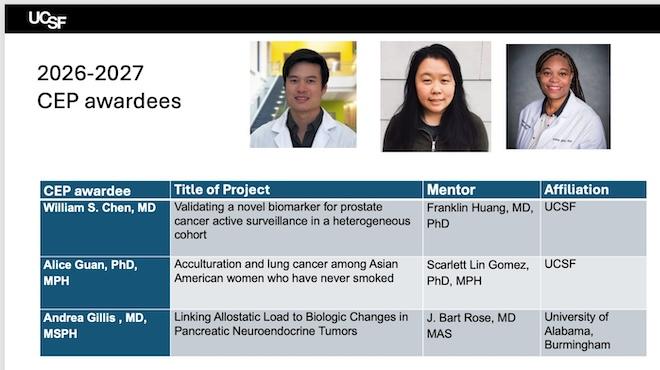
CEP awardees
Most men with prostate cancer are diagnosed when the disease is in its early stages, but current tests often cannot accurately distinguish which patients need aggressive treatment. William S. Chen, MD, an assistant professor in the departments of radiation oncology and urology, has developed PROTAM, a test that screens for aggressive disease based on the presence of a type of immune cell called a myeloid cell in a patient’s tumor. Working with his research mentor Franklin Huang, MD, PhD, Chen is using his CRP award to further validate this novel biomarker.
Alice Guan, PhD, MPH, an assistant research scientist in Epidemiology and Biostatistics, is continuing her research with UCSF epidemiologist Scarlett Lin Gomez, PhD, MPH, examining why rates of lung cancer are rising in among some populations who have never smoked. She is interested in how both genetic and environmental factors may be influencing cancer risk.
Physicians base the clinical decisions about treatments for pancreatic neuroendocrine tumors on the size of a patient’s tumor. However, a patient’s life circumstances can also influence the genetics of their tumor. Andrea Gillis, MD, MSPH, an assistant professor in the surgery department at the University of Alabama at Birmingham, in collaboration with J. Bart Rose, MD, is assessing how chronic stress shapes the biology of these tumors through a measure known as allostatic load.
“We look forward to seeing how these talented young investigators will change our understanding of aggressive disease and how to develop more targeted interventions,” said Shawn Hervey-Jumper, MD, the CEP director and the Mitchel S. Berger, MD, endowed professor at the UCSF Weill Institute for Neurosciences.
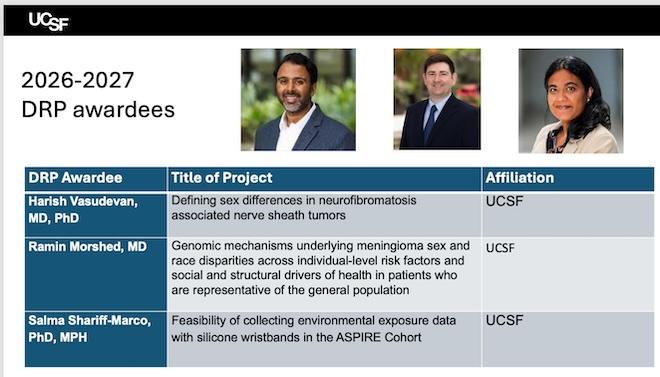
DRP awardees
People with the genetic condition neurofibromatosis (NF) are at higher risk of developing tumors along their nerves. Some of these nerve sheath tumors can progress into malignant peripheral nerve sheath tumors (MPNSTs), a deadly, aggressive cancer with no currently approved treatments. Harish Vasudevan, MD, PhD, an assistant professor in the departments of radiation oncology, neurological surgery, and cell and tissue biology, has identified differences in the genetic alternations in tumors from male patients that may help explain why men develop MPNSTs more often and form the basis for future targeted drug therapies.
Meningiomas, the most common type of primary brain tumor, are more common in certain populations. Ramin Morshed, MD, a neurosurgeon and an assistant professor of Neurological Surgery, aims to evaluate how individual-level risk factors influence meningioma biology. His DRP award extends several UCSF-led studies that identified the genetic and molecular factors driving the growth and evolution of these brain tumors to a broader cohort of patients.
Exposure to chemicals commonly found at work, home, and outdoors could be linked to the rise in cancer rates among some populations. Salma Shariff-Marco, PhD, MPH, a professor of epidemiology and biostatistics and the co-director of the Biostatistics and Population Shared Resource at the Helen Diller Comprehensive Family Cancer Center, is measuring these chemical exposures through silicone wristbands in a small cohort of participants. Her DRP pilot project will help inform the design of a larger study in the national ASPIRE cohort.
--
Looking Ahead to the 2027-28 Cycle
The next deadline for the Cancer Health Outcomes SPORE’s DRP and CEP RFA is May 1, 2027.